Статьи
Source: https://medinskiy.ru/article/diplomaticheskiy-triumf-sssr.
USSR’S DIPLOMATIC TRIUMPH
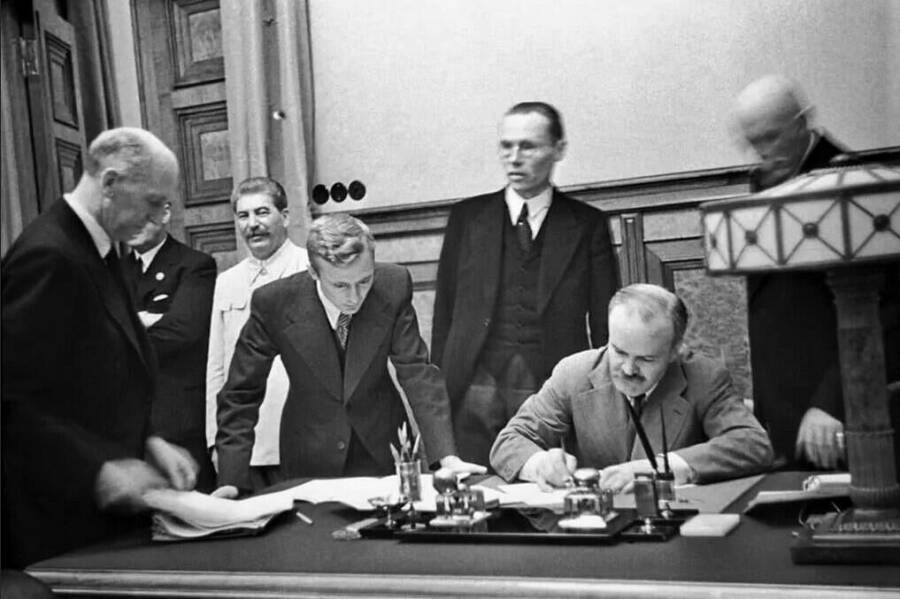 CC0 / /
That's what I called the chapter in my book "The War. 1939-1945" published 10 years ago. The one about the Molotov-Ribbentrop Pact. It was on the edge of decency at the time. Oddly enough, it sounds like a revelation even now. Let’s explain.
"The victim of Perestroika"
The Soviet government made a serious mistake on the "ideological front". It concealed the truth about the secret protocol to the Soviet-German non-aggression pact of August 23, 1939 ("The Molotov-Ribbentrop Pact"). During "Perestroika," the then still-Soviet people were startled by a host of unmasking maxims and intrusive ideologemes that exposed "Stalin's foreign policy.
The same thing was repeated over and over again: in August 1939, two tyrants divided Europe and started World War II. They also thought to divide Asia, to take from democratic England the blossoming under British supervision India (refer to Molotov's visit to Berlin in November 1940). But here they didn’t agree, because of the exorbitant "imperial ambitions" of the worst of tyrants - Stalin.
Soviet history textbooks were declared false and outdated, because there was a lot of "superfluous" information there. For example, that exactly the same "pacts" were signed with Hitler by other states. That the turning point of a pre-war history was the Munich contract of 1938 when Czechoslovakia, one of 5 largest countries in Europe by GDP, was simply "prescribed" by 4 others (England, France, Germany, Italy), to accept Hitler's ultimatum and to give Germany the main part of its territory in the military and industrial terms. A few weeks later, the prosperous Czechoslovakia ceased to exist as a country. "They sold me into slavery to the Germans, as the Negroes were sold into slavery in America," with these words Ambassador Masaryk (the son of Czechoslovakia's founder, Tomas Masaryk) threw himself on the chest of the Soviet ambassador in London. Czechoslovakia was betrayed for the sole purpose of directing the Fuhrer's further aggression - to the East, to the USSR.
Soviet textbooks also "misrepresented" the pre-war conflicts with Japan - at Lake Hasan and the Khalkhin-Gol River. They didn’t tell that there was a real threat of war on two fronts for our country. About how the USSR repeatedly offered London and Paris to conclude a military alliance against Germany. About the full failure of the Anglo-French-Soviet negotiations in the summer of 1939 - because of Britain's desire to pit Hitler against the Soviets and not to bind itself at the same time.
The logic of cause and effect and the general context of world contradictions on the eve of World War II suddenly became irrelevant and uninteresting. The apotheosis was the hysterical denigration of the "pact" by the Congress of People's Deputies in 1989.
Now, on the 80th anniversary of the Pact and the outbreak of War - it goes on everywhere. From recent publications. "The Polish Radio”: "By undertaking aggression on Poland, Stalin helped Hitler". "Figaro" (France): after the publication of the secret protocols for the Baltic Republics of the USSR "the desire for independence became not just a political matter but a moral obligation". "National Review” (USA): "The alliance of two tyrants has upset the balance of power and undermined military deterrence". "The Guardian” (Britain): "Russian imperialism is gaining momentum again" (here the newspaper quotes its own comments from 1939!). And so on...
I believe it’s necessary to discuss the circumstances and consequences of the "Pact". So that the public can understand the difference between the primitive ideological interpretations of these events and the realities based on knowledge of the facts and documents.
Only then it will be finally recognized: in the specific foreign policy situation of the summer of 1939, the USSR was right to agree to a non-aggression treaty. Proceeding from the priority of the interests of a specific sovereign state. Our state. And the lives of concrete people - our citizens. And not abstract fantasies, assumptions, "humanitarian" messages and, unfortunately, the so-called "common European values" which existed then only in the heads of individual idealists, but not real politicians.
It’s time to take our minds off both Stalin's demonic personality and our personal allegiances to one or another of today's political views and values.
True, referring to the "preparation for the War", it’s unseemly to try to justify those who are guilty of total lawlessness, terror against their own citizens, mass repressions, the madness of defarming, the overkill of industrialization, the construction of a generally idiotic state economic doctrine, etc. But at the same time we must acknowledge another thing: in 1939 the Kremlin acted in the sovereign interests of the peoples of the USSR, defending their right to exist. We are entitled to draw such a conclusion because we know what happened later, in 1941-1945. We know what accusations were made at the Nuremberg and Tokyo trials and what the verdict was.
Thus, we can regard the pre-war political crisis as the first battle of the Second World War. Its outcome determined the direction of Hitler's aggression in Europe and Japan's aggression in Asia. Everyone involved in the future global conflict tried to participate in writing its future scenario.
"The Window of opportunity"
While judging the treaty itself and its secret protocols, for some reason no one says - what should the Soviet leadership have done in the real circumstances of the time?
Proudly refuse Hitler's offer, fly to London and kneel before Chamberlain? Beg him to agree to an anti-Hitler coalition? That’s exactly what we’ve been proposing for years, since 1933. It didn’t and could not work, because the British scenario was based on the very idea of pitting Germany and the whole fascist "Black International" against the USSR. And then sending the French army to "pacify" Europe, getting maximum dividends with minimum involvement in a new war.
By the way, theoretically, even if Britain had given its consent, it would have guaranteed nothing. Without the willingness of the Poles to fight against the Germans together with the Red Army, it’s impossible to imagine how the USSR could have stood up to Germany. Poland refused even to talk about a military alliance. Everyone remembered how a year ago it refused to let Red Army units through a "corner" of its territory in order to defend Czechoslovakia against the Germans.
Let's suppose we had said no to Hitler's offer of a "Pact". What would have happened then? In September 1939, the Wehrmacht smashed the Polish army in two or three weeks, and occupied the whole of Poland. Next...
Nothing prevents the Germans from separating a "sovereign" Ukraine from the western Ukrainian lands by placing Ukrainian nationalists who have long collaborated with the Abwehr at the head. Then, appealing to the "right of the Ukrainian people to self-determination", they would demand the liberation of the "enslaved by Bolshevism" population of the Ukrainian SSR - similar to the Sudeten Germans. The Gauleiter-Banderers would form not just one "Galicia" on our western lands, but as many divisions for an attack on the USSR as the Führer would demand.
Next... Long before August 1939 The leadership of the "Third Reich" began talking of a protectorate over Lithuania, Latvia and Estonia. All the armies of these countries, all their armaments would be used for the invasion according to the plan "Barbarossa". Those countries would provide resources for the fascists. In reality, the Baltic divisions joined the Red Army.
Next... Finland. The border on the Karelian Isthmus still passes just below Leningrad. Finland becomes Hitler's voluntary ally, just 30 km away from the center of Leningrad. Within artillery range. Leningrad (the symbol of the country and more than 30 % of the military industrial complex of USSR at that time) would fall at once, in June of 1941. Can you imagine? By the way, plans of creation of the Greater Finland, which was to include the whole Russian North up to the Urals - they aren’t less known than documents of the "Pact". The first target was Leningrad. And there it was, on a silver platter!
Next... In Japan, the Hiranuma cabinet, which was seriously considering a joint campaign with Hitler against the USSR, would probably have remained in power. The lust for revenge for defeat in Mongolia would only have pushed it to the "northern" version of Japanese aggression. Would the USSR have been able to withstand a two-front war? How many tens of millions of victims would this war have cost us? Where would then be our Stalingrad? In the Urals? In Siberia?
Finally, England... It probably would have remained neutral, even expressed sympathy for us. But British pragmatism in foreign policy is a well-known thing. And we would not have been surprised to see the British first - even before the Germans - in the oil fields of Baku.
Fans of alternative history sometimes suggest that Moscow should have agreed to receive Ribbentrop on 23 August 1939, to sign the treaty, but without the secret protocol.
But what were we to do after Hitler's lightning-quick defeat of Poland? Suddenly act "in defense of the Belarusians and Ukrainians", ask Hitler to make a "goodwill" gesture and give back Vilnius, Brest and Lvov, which had just been occupied by the Wehrmacht? It was all was Russia, please give it back. It would lead right away to war with Germany, already in autumn of 1939. Japan would also step up.
Should we have given up the "Pact" and sat waiting to be attacked from the west and the east at the same time? Hitler would decide to implement what he proclaimed as his main goal in "Mein Kampf", and his tank wedges would rush to Moscow from the old border line. Only their path would be 300-400 km shorter...
Fortunately, at least as far as foreign policy is concerned, there were no idealists or idiots in the Kremlin at the time, which is why the Kremlin didn’t miss its life-saving window of opportunity.
Lessons from the past, a test of the present
Everyone knows: Lessons from the past are needed to learn, to understand historical experiences, and not to repeat mistakes.
The "pact" was a forced, albeit legitimate, deal with an unquestionable enemy. The USSR bought time to prepare for the war. It brought discord to the coalition between Germany and Japan (the latter had signed a neutrality pact with us in spring 1941, without ever having decided to attack - even in autumn of the same year). When the Red Army, having gathered its last forces (and Siberian divisions!), launched a counter-offensive at Moscow, the Japanese fleet was on its way to Pearl Harbor.
The secret protocol and the "spheres of interest" fixed in it made it possible to avoid war with Germany after the defeat of Poland. The Red Army kept Western Ukraine and Belorussia out of the hands of the Nazis, salvaging our border to the west as well.
Being able to negotiate in one's own interest with any unfriendly party (being perfectly aware of who is who - again, think of Stalin and Molotov as scoundrels, but definitely not as fools) is diplomacy.
80 years ago they did just that.
By the way, the lessons of the "Pact" came in handy for the victorious generation itself. After all, Yalta is essentially the same Non-Aggression Pact, only on a global scale. The Pact of two equal projects on a civilizational scale - the Soviet and the US - on the rules of competition, on voluntary self-restraints and on the global institutions of international law. It’s the Pact of the smart and the strong, who reasonably felt that it was better to be competitors than enemies. It’s the Pact that laid the foundations of World Peace for decades to come.